Thursday, July 17, 2014

It’s a Rally, not a Race…


The Marvelous DelMarva

There is an outfit called the World Cruising Club.  They organize and manage several coordinated sailing events under the umbrella of the Atlantic Rally for Cruisers (ARC) which was originally established to put cruising or racing boats in an organized fleet to more safely make the 2,700 mile ocean crossing from the Canary Islands to the Caribbean. It caught on, and more ARC Rallies were created, now even including a world ARC circumnavigation rally.  The organizers collect fees for your participation and in return you are provided with lectures, books and video materials, safety inspections, discounted docking, some free meals and parties at stops along the way. Most of all you are included in a network of like-minded and similarly destined sailors, many of whom use a rally to accomplish their first ‘big’ sail.

We did just such a thing in early June 2014.  Our ‘new to us’ sailboat is a complex affair and we hoped to use a rally opportunity to shake out the boat, learn how to manage systems and crew schedules and put together a list of things that needed to be done before attempting an even bigger event this coming November; a non-stop sail from the mouth of the Chesapeake to the British Virgin Islands.

The particular June rally that we joined is named the ARCDelMarVa because it goes around the peninsula between the Chesapeake Bay and the Delaware Bay, encompassing the states of Delaware, Maryland and Virginia.  The trip is around 450 nautical miles (if sailed in straight lines) and is scheduled to take a week including stopovers along the way.  The plan is to leave Annapolis on a Sunday morning and be back for the closing dinner the following Saturday.

Robin and I had originally set our sights (and paid the entry fee) on the bigger rally in November called the Caribbean 1500.  It has a 25 year history of successful ocean crossings leaving from Hampton (this year Portsmouth), VA and ending up in Tortola, BVI. The trip is about 1,400 nm in a straight line (which is really a curved line as far as navigation is concerned) and takes around 10 to 12-ish days depending on boat and weather conditions.  The route crosses the Gulf Stream and goes well off shore (maybe 400 miles offshore!) into the deeper parts of the Atlantic. 

All boats have to be inspected, carry all kinds of safety and communications gear and there are tracking devices on each boat for progressand position reporting. There are scheduled radio net check-ins and custom weather reporting services provided for entrants.  Of course, you can read all about it here J
When Robin and I decided firmly that this is what we would like to do (it only makes sense to cut your trans-Atlantic teeth within an organized group) we signed up and attended our first Atlantic sailing seminar.  While we were there, the idea of also doing the DelMarVa Rally popped up and we decided to go for it as well.  One can never have too much experience on the water and this looked to be a great opportunity to get things together before the bigger step in November. So … we pulled the trigger and signed up.  
Now, all of a sudden, we were in a hurry to get ready.  It’s amazing when you think you have seven months to prepare, and suddenly that whittles down to just a few weeks. But we took the prepared checklists and went shopping, started studying up on what would be required for the route and made our reservations at the interim marinas.  All in all, it was a great thing to come under a little pressure as we moved on things we might’ve waited on until the last minute otherwise. 

On the day that we brought the last few piece of safety gear aboard, we had a surprise visit from the Annapolis Power Squadron, a division of the Coast Guard Auxiliary.  The team was out doing inspections on boats and we actually passed, with just a couple of small ‘to-do” items to accomplish to make it a perfect inspection. Who knew??  I need to sincerely thank the folks at World Cruising for putting together the checklists. It is directly due to them that we were accomplishing all the compliance items and it was certainly a pleasure to receive a ‘pass’ from the Coast Guard and get our little orange triangle sticker. We are almost fully compliant with the rally guidelines (we still have to either service or replace our life raft) so it is now a matter of making sure we know where everything is stored and how to use it.
OK, so about this DelMarVa Rally thing.

It came to pass that our dear friend Erle could join us for the entire voyage so we were glad to have him come out.

We were also notified that Lauren Saalmuller from Sail Magazine wanted to join us for the first leg. 
That was way cool! .. and a bit spooky … I mean, the Assistant Editor for a major sailing publication wants to come aboard and crew with a couple of inexperienced sailors on a new boat?  What could possibly go wrong?? But, we were glad to have her aboard and she turned out to be a wonderful crew member and lots of fun to visit with.  Can’t wait to see how the article reads! (Look for it in August, I’d guess).

The day before the rally start (6/7/14) we re-positioned the boat from our slip in Deale, MD to a slip in Annapolis. It was a nice journey up, but the wind was right on our nose so we had to use the motor for the whole 3 hour run. Coming into the Annapolis Harbor area, I misguided us ever so slightly and we turned up the wrong creek (Spa Creek instead of Back Creek) but it was a fun little tour of the area .. and no one else knew I didn't mean to do that until we started heading back out.  For fun though, just as we started back outbound a small … I mean like 16 feet ... sailboat tacked and came about directly in front of us. Now, we were motoring, so by rights the little boat had right-of-way since they were sailing, but I don’t know how brave I would be to claim that right when a boat that could slice me in half was bearing down on me in close quarters.  We had no room to maneuver at all and so I basically had to slam on the brakes as they sailed by us a few feet off the bow. The best part was the lady at the helm who, looking up at us in a boat more than three times her size, simply shrugged her shoulders as she glided by. Well, I guess it’s like walking blindly out into a crosswalk and just assuming the drivers will stop.  Works until it doesn't. The memory of the shrugging lady will stay with us for a while. What was she thinking?? 


We found our way to our assigned slip at Annapolis LandingMarina and began making final preparations for the Sunday morning start. There were things to stow, groceries to buy, water and fuel to fill and checklists to run through. I changed the engine oil and got things ready to go.  We all attended the pre-rally function in town and got to meet several other sailors who were doing this rally for reasons similar to our own. We are new at it and wanted to try within the safety net of an organized event.  There were a lot of first-timers at the briefing and it validated our decision to do the rally.


The crew was all briefed and ready, the boat was ready and we left the fuel dock 45 minutes prior to the start of the rally. Should’ve worked like a champ, except we didn't really understand where the starting line was J.  No matter, we just motored out to join them as the fleet, in all their full-sail-pennant-flying glory crossed the starting line and the Rally was officially underway.  There were photo-op boats circling around and it all ended up working out just fine.  No one except you and I know that the #5 marker we were waiting at and the #5 marker everybody else was waiting at are ½ mile apart. All those pretty boats with all the sails up were a dead give-away that we hadn't quite hit the starting line spot on. 
In reality, we were quite content to not be in the thick of it mixing it up at the starting line.  It’s a rally, not a race (remember that…) so the actually start is more of a formality.
We crossed the start line in great fashion, appearing for all the world to know exactly what we were doing   and we headed out into the Chesapeake Bay.
A couple of things became readily apparent as soon as we cleared the harbor’s waters and entered into the bay.  First; the forecast for 5 to 9 knots of wind was woefully wrong.  We were looking at 12 – 15 knots and, miraculously, it was right on the nose (again) if we wanted to go south (sigh). Second; all those pretty pennants and flags that Erle had spent so much time hoisting were not going to last long in a stronger wind, so down they came.  Third; we’d not really tacked the boat before so it was going to be a fun exercise in bringing the boat around, back and forth, all the way down the bay. Fourth; … this was way cool fun stuff that we’d been dreaming about for years!
Our first tacking exercise went relatively well, and with each successive tack we got better at not having the sail or lines snag as they passed through from one side to the other.  We took long tacking legs; from one side of the bay to the other and the boat made good speed into the wind … but not such good speed toward our target. This is the way of things when sailing and would not be so much of a worry out in the open ocean, but we had two limits on us: the width of the bay and the appointment in Portsmouth for dinner the next night.  Still, we tacked on and surprisingly passed within a few boat lengths of another rally participant going the opposite tack on not less than three occasions. Fun to know that we were all pretty much making the same amount of slow forward progress.
Well, after sailing about seventy miles through the water we’d only made about 21 miles “upstream” into the wind (that’s sailing in a nutshell some days). It was beginning to get dark and we decided to not tack all night long, crossing back and forth over the shipping channel and through unfamiliar waters with an inexperienced crew.  Good call, I’d say. So…after about 10 hours of tacking we rolled in the sails and turned on the motor.  Now we were making 7 knots directly toward our destination and the crew could start taking shifts (watches) navigating us toward Portsmouth. 
The wind increased, the waves built and except for it not being bitter cold, it really resembled the delivery run back in March where we pounded up the Delaware Bay in a gale.
Winds increased to 20 knots with some gusts to 25 but the boat had no trouble making way although we slowed to 2-3 knots at times. We got ~some~ rest and during the night we heard about other rally boats that had headed to shore to find a rest stop for the night. We also heard that one boat had engine trouble and another had a sail problem forcing them to drop out. We pressed on till daylight, hanging close to, but not in, the shipping channel and spotting the occasional cargo ship along the way. Those things are absolutely huge!

 Each crew member took a three hour watch through the night.  We spent some time doubled up when passing through the busy entrances to the Patuxent and Potomac rivers.  For the most part, motoring along meant checking your position against the plotted course and trying to see out into the dark through the wave-splashed windshield.  Except for the wind and pounding waves (not big waves, just ones that made you lift up a bit, then slam into the next one) the trip was uneventful and daybreak brought a little relief from the wind; not in direction, but in speed.  We still had to motor into it. 


A great treat was had when we passed several “Tall Ships” heading north on the bay the next morning (Monday 6/9).


There had been a festival of some sort in the Norfolk area and a collection of these majestic wooden schooners were now proceeding back to their respective home ports. Since we were just motoring along, we varied off course a bit to go see them as closely as we could without being a nuisance. We got to exchange waves with a few crew members and took a lot of pictures. It was very cool to see these replicas moving slowly northward, using the wind that we had been fighting all night.

We rounded the lighthouse and went into the Norfolk Harbor. There is a huge Naval installation there and our crew member Erle, an avid Navy man, was in his element looking at, and looking up, (we had cell coverage so Google was the name of the game) all the different types of ships and hardware that were station just a few boat lengths away. Of course, the security boats made certain that no tourists got too close; something we did not care to test.


Motoring south on the Elizabeth River we arrived at Ocean Marine Yacht Club in Portsmouth, VA well before dark. After taking on fuel and water and we wandered the streets of Portsmouth looking for food at just a few minutes after 9 P.M. … a few minutes after a lot of places had closed.  We did find a nice spot and had a great dinner time of de-briefing and visiting about what we saw and did. All told, leg one was very successful even if the winds and water were against us.

We spent the next day (Tuesday 6/10) waiting for other boats to arrive before having a crew briefing.  Then we went for a big group dinner … at the same spot we’d found the night before!  Wouldn't you know it?  Nevertheless it was a great time socializing and we met new friends from another rally boat and it was great to be a part of the ‘society’ of cruisers for a while.

This day, 6/10/14 also marked our 8th Anniversary. It was impossible to squeeze out any private time, but it was still a very special day. I am so truly blessed to be married to Robin. She is just amazing. The very fact that we are having an anniversary aboard our cruising boat is a testimony to the support and encouragement that she has given me. I could not have done this without her. So there!!

Wednesday we departed at 8 A.M. for the second leg of the rally. This would be the one that took us off shore and into the Atlantic as we sailed from Portsmouth, VA to Cape May, NJ. The trip was noteworthy for two reasons:  1> somehow the winds that had been out of the south for 2 days on the Chesapeake were now out of the north on the ocean. Really? And 2> they weren’t strong enough to dissipate the fog.  Ah well, here we go again. Turn the motor on and settle into the humming routine of 5 kt motor-boating. .  Follow the plotted line and we will see how it all comes together on the other end. Boring?  Well, yes and no.  You still have keep a close watch; there are 20 other boats out there in the fog doing the same thing.   We talked about trying to make the wind work for us; sailing far offshore and then using the wind to bring us back in, but we were only three on crew now as Lauren (the editor from Sail Magazine) had moved to another boat for the second leg. Shorthanded sail management wasn’t something I was really up for so we just set the throttle at 2,000 RPM and let the little Volvo TMD-22 motor purr along for most of the day and all night. We had some pretty cool ‘sightings’ in the fog when a ghostly sailboat would materialize out of the fog and keep pace with us for a while. Not quite the Black Pearl, but nonetheless a pretty ethereal event.
The entrance to the marine in Cape May, NJ show a good water depth except right at the marina entrance. It is charted at four feet and we need seven feet to be comfortable in not scraping the bottom.  Fortunately for us, there is a (nearly) five foot tidal range at that location so it just means we are ‘slaves to the tide’ as we must enter and exit the marina only at or near high tide.  Luckily for us (I would claim fastidious planning, but any sailor knows better than that…) we would indeed arrive around 8 A.M. which was very close to high tide.  We slid into the marina and found a spot to tie up right at the fuel dock, which was convenient as the boat was a bit thirsty J
The last part of this leg proved to be challenging and not without incident.  As we approached the opening to the Delaware Bay, we had to cross 4 major shipping lanes (2 in each incoming and outgoing directions).  I was below, sort of snoozing, when I heard the engine RPM drop to idle.  Well, that’s something that’ll get your curiosity high pretty quickly. Actually, Erle had reduced our speed to near zero in order to allow a huge RADAR blip to pass in front of us.  The fog, you see, had never lifted and in fact was very thick through this area so having the RADAR to avoid big ships was critical.  We had been motor-sailing, just to (maybe) gain a half a knot of additional speed but decided to roll the sails in and finish the last few miles just under motor.  Then ... it happened.  Somehow, while rolling up the jib sail, a line got tangled up in the mechanism at the top of the sail, right where it attaches to the main mast. We could not see it happen and didn’t notice anything wrong except the winding motor labored a bit. I thought we had a sheet (a line that attaches to the bottom of the sail that was dragging, so we unwound it a bit, made sure the bottom lines were clear and began winding it again.  There was a ‘crack’ sound and two long lengths of line tumbled onto the deck from above. Both the jib and spinnaker halyards had gotten wrapped up in the furler and snapped, along with a third halyard used for supporting the spinnaker pole. These two big halyards are rated at (at least) 7,000 pounds of braking strength, and the smaller one maybe half that. The furling motor snapped them and we didn’t even really feel it labor to do so. Now that is some serious power in a 24v electric motor.  Nonetheless, we took some damage aloft, and a section of our life-line railing on the deck was bent upwards at the point a 5/8" halyard was tied down.


We were done using that sail, or any sail for that matter, until we could get a complete inspection and assessment of the damage. One thing NOT to do is risk bringing down the whole sail rig by putting it under a big load after an incident. We would have to motor-boat the rest of the trip home.
The morning at the marina, Andy Schell (the event organizer) offered to go aloft and take a look at the rig.  His inspection revealed very little damage, but with broken halyards there was nothing to hold the sails up is we unfurled them so it confirmed our motor-boat status.  The group put on a pot luck and we spent a pretty comfortable night at the fuel dock.  Thus begins leg 3.
On the morning of the 13th (Friday, no less) we set out into the Delaware Bay for the last leg of the trip. The water in the channel and out in the mouth of the Bay was glassy smooth, and although not as thick as the previous time it was still hazy/foggy.  We left at high tide and had no problems exiting the marina or channel.
Most of the other rally boats had departed much earlier, on the order of 2 A.M. in order to take advantage of the tide in another way; when the tide is low and coming in, the Bay ‘floods’ as the tide comes in and prides a current to help push you northbound.  Since we were strapped to the high-tide departure, it meant that we would be fighting the ebb tide all the way up the Bay. Ah well, can’t win them all.  The morning and early afternoon we beautiful and we motored right alongside the shipping channel, spotting a cruise ship and several tankers and cargo haulers. The weather forecast called for a line of thunderstorms, some sever, to be forming along the land and moving off shore and sure enough, the RADAR started picking those up as we made (slow) progress northbound. Some of the rally boats encountered some rough weather, some of the ones that head left early enough to make into C&D Canal before the thunderstorms hit had sought shelter in a marina and a couple had chosen to take shelter in a couple of ‘protected’ anchorages along the bay. 
Looking at our RADAR, it appeared that the storms would head right at us, lightning and thundering along the way, but either dissipate into rain showers or pass in front or behind us.  The line was clearly defined and once it had passed there was clear air behind it.  We got some winds and got rained on, but we never encountered any ‘rough’ conditions. Fortunate for us J
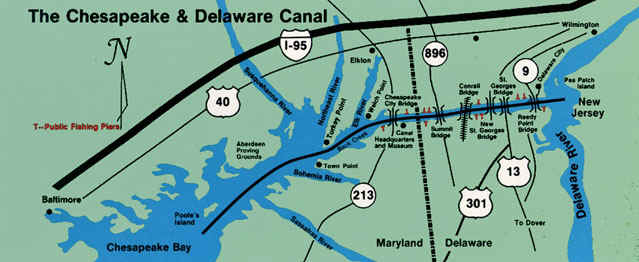
At around dusk we entered the C&D Canal. A 14+ mile cut between the (C)heasapeake and (D)elaware Bays. The weather had cleared and we were treated to a wonderfully smooth ride through the canal. It was decided that we would keep two crew on deck; one to steer and navigate and one on watch for traffic and hazards. This meant 6 hours-on, three hours off; a pretty brutal schedule.

Fortunately it would not be for a long time (only during the dark hours), but it was still a tough watch schedule. I, however, am so very glad that we exercised that option.

The Canal, while nicely marked and well lit, is still a very dangerous place because of the large shipping traffic. During these watches, we came very close to very large ships a couple of times. Having someone on the spotlight and on the radio was critical to finding and avoiding these guys; they use most of the channel.   We motored through the Canal, out into the channel entrance to the Chesapeake and cleared the Bay Bridge all the while trying to spot and identify each and every marker and range light. It was still quite dark at 0430 when we arrived at the shipping anchorage area near the Annapolis Harbor entrance. I opted to slow down and travel outside the harbor until we at least had some kind of daylight to work with.  By 0545 we were headed into the harbor and shortly thereafter docked up on the Annapolis Landing Marina fuel dock (which we’d been kicked off of nearly a week earlier).
I was told at the skippers' briefing prior to the beginning of this rally that it has been called one of three things ... the "Del-Marvelous", the "Hell-Marva", or the "Del-Motor".  I guess we got the latter of the three. 70+ hours of engine time.  Nonetheless, it was a worthwhile, interesting, educating, networking and FUN time.

Mission accomplished …  Nap time!


Friday, July 4, 2014

Getting to know you.

Getting to know you

Getting to know all about you….  Thus begins month one of full-time living aboard.  We are still not completely out of our coach, which is now in nearby storage with For Sale signs on it and we still have a few things that we ‘just aren’t sure what to do with such as:
--An air compressor. Does anyone really need an air compressor aboard?
--My telescope. I definitely see that I would love to have it on a dark-skies beach somewhere, but it takes up quite a bit of space in its case.
--My home computer. I’m going to miss the Alienware Aurora with its high horsepower and 24” screen big time. But, it’s big, and heavy and I don’t have a clue how the salt-water environment can mess with the components.

Tent and lawn chairs and sleeping bags. Would be great for when we want to go camping off the boat on some deserted tropical island, but that logistic and the space requirement may not be realistic.
There are a few more items of ‘interest’ that we’re just no sure about, and it seems as though we have already moved into most of the available space aboard. So, in order to accommodate more ‘stuff’ we are probably going to have go end to end and re-sort, re-stack, re-store and re-think what we have already loaded aboard.  Everything I have read on other cruisers’ blogs have indicating that storing stuff is ultimately a waste of money. When you go cruising, it changes you fundamentally about possessions and when you return after one or two or nine years, the ‘stuff’ you had stored does not have its same meaning or attachment. To that end we’d like to be as completely free as possible before setting off for any distant place.

Technically, today (June 30th, 2014) marks the one-month point since we unplugged the coach and moved onto the boat ‘for reals’. We hitched up the coach and pulled it into storage nearby to the docks and loaded out the last few things (for now).  I put on a small solar trickle-charger to keep the batteries topped and we turned our focus fully on settling in to the new digs. We are learning a lot…

The boat has lots of storage, there are nooks and crannies and lifting floorboards, and cabinets and lockers and cubbies and shelves and drawers to be filled. And guess what? … we’ve filled them. Figuring out where to put stuff, based on priority of access, has been quite a challenge.  I stored ‘geek’ stuff under a floorboard (for a while) but later moved it to a more accessible drawer. It’s a different train of thought to say “well, I need to print this out so I have to dig out and set up the printer” each time. Same with the scanner, which gets used frequently as we digitize most incoming documents (paper doesn’t hold up too well in the long run with high humidity).

The pantries are well stocked, but to access some things you have to remove two layers above it. His causes you to think about what gets used most often and what’ll get layered down.  Bulky things, like comforters and pillows, have to be squished tightly to fit into their spots.  You get the drift. It is a new way of thinking about your available space.  Nothing can be left out, basically. Everything has to be put securely away in order to handle potentially rough water and prevent breakage. Of course, If we’re going to be spending some time at a dock, we can break out the ‘fragile stuff’ and hang up the pictures J
On the mechanical end, this boat is a collection of systems waiting to be explored (and eventually repaired, I’m sure).  Adagio has a 78hp Volvo turbocharged diesel as her main propulsion with a three-bladed folding prop mounted to a reverse-drive transmission.  Oil, filters, grease, seals, impellers, belts, engine mounts and … well, you can see where this is going. A new regimen of maintenance days is in our future. No Jiffy Lubes around out in the ocean.

The boat has an auxiliary generator (6.5kW), a water maker (desalinator), pressure water pump system, 12v, 24v, 110v and 220v electrical busses radios, RADAR, air conditioning and even a washing machine (as small as it is, and it only washes, not dries). There’s a propane system with manual and electrical shutoffs for the stove, a water heater run by either engine heat or 220v electrical and a small TV. 
Lots of creature comforts (we do not intend to make living aboard akin to camping aboard) but also lots of systems to keep up with and learn about. Oh… and it’s a sailboat … 11 winches (3 are electrically driven) 5 sails, 1200 feet of line in various diameters, strengths and conditions. Pulleys, turnbuckles, chain plates, anchors, and much, much more.   It’s going to be a while figuring out all the systems and mechanics but it needs to be done.  We, as owners and sailors, have to be pretty fluent in everything about the boat.  It’s not quite like ‘knowing’ about the house or car, because everything has the potential to break at an inopportune time when it can become somewhere between inconveniencing and life-threatening. 

I’m happy to have a mechanical and electrical background where a lot of the mysteries can be revealed through experience in other things. Having owned the sailboat “Robin” for more than 5 years we’ve learned a lot about how things work on a smaller, less complex scale and so this isn’t quite as intimidating as it could be. But it is still a bit daunting to say the least.

So, in the month of June we learned … a lot … and there is still a lot to go. We know how to start the engine, maneuver and sail the boat. We know how to get electrical systems and lighting up and running (even converted a lot of the lights over to L.E.D.s J) We know how to fill fuel and water and empty out other tanks (a day long story unto itself with that one..). I know how to rebuild winches. We can run (most of) the radios and navigation equipment and can even make the microwave work.  We’ve found storage for most of our stuff, organized it in some logical places (safety gear takes up a whole closet …  who knew?!?).
There are still things we look at and wonder what they are for, and I’m sure we will puzzle out things like the awnings and all the spare lines and Ham Radio and how to get printed out weather faxes but we have a few months yet.

This is just our first J


Saturday, June 21, 2014

Retirement, at last.


REFLECTIONS ON A CAREER.

 This blog was kind of designed for sailing and boat owning and dreaming and suntans and slowing-down kind of thoughts and records, sharing what we’ve been up to, places we’ve gone and things we’ve seen.  Having said that, it only seems right that we wouldn’t spend a lot of time on things un-sailing-like, but in fact, most of the blog to date has been about just that. Stuff, happenings, circumstances, successes and trials that have brought us to the point of posting a blog entry from the dining table aboard our cruising vessel. To that end, and having just made a significant life change we figured it’d be okay to wax a little poetic about the jobs that put us in the position to eventually make the dream turn into reality.  Hope you’ll bear with us J

Gary:

First job: Auto Parts sales while still in high school. 1971
U.S.Air Force 1972: Nuclear Weapons Technician
J.S. Motorcycle: 1975: Mechanic and service manager.
Moved from Sacramento, CA to Cheney, WA in 1976
1976: Ranch Hand/Implement mechanic
U.S. Postal Service: 1977: MPLSM Operator (Spokane, WA)
Westaire:  (Coeur D’alene, ID) 1979: Flight Instructor
Casper Air Service: 1980: Flight Instructor/Charter Pilot (Casper, WY)
Rocky Mtn. Aviation: 1981: Chief Flight Instructor. Charter Pilot (Casper, WY)
KCWY, FM Radio: 1982: Radio Air Time Sales (Casper, WY)
United Standard Distributors: 1982: Corporate pilot (Cheyenne, WY)
Sun West Aviation: 1983: Charter Pilot, Air Ambulance pilot (Ogden, UT and Walla Walla, WA)
12/07/1984: Hired as an Air Traffic Controller by the FAA.
4/31/2014: Retired as an Air Traffic Controller. 29 years, 5 months, 23 days later.

There’s a resume for you.  It speaks to years and places but not of people, experiences and feelings.  That would take a lot longer, and perhaps ought to be hard-bound and titled … ummm … I know; “The Story of my Life” or something like that. I think that’s a unique longing for many people: to somehow capture the essence of all their experiences, trials and search for significance through their jobs. I know that I’d certainly like to see it all on paper somehow, but I’m not totally sure why. Maybe it’s all just to sum up the idea that it all made some kind of difference and the effort, odd hours, commutes and politics were all ‘worth it’.  No matter… Here’s how I’ll sum it all up:

Hell of a ride… 35 years of Government service. I had some amazing opportunities (like getting a half hour of landing practice in the Space Shuttle simulator) and some amazing trials (working rotating shifts is just flat not healthy…) but sometimes reflecting on it all it somehow seems like single, lump-sum thing rather than a day after day string of weeks, months and years.

But I have evidence of those days. I have a flight log filled with a couple thousand entries of each day’s work and some high adventure to boot.  I have training certificates and performance letters (mostly good) and photos and business cards and pins and other memorabilia that can be strung together to put a ‘sort-of-timeline’ story to this past 35 years.  It is just a series of reminders that some cool, even amazing, stuff happened along the way to the place I find myself right now.  Highlights would include flying with the Governor of Idaho, meeting Bob Hoover, dropping incendiary flares for Morton Thiokol from the back of a Piper Seneca, saving a life by being able to get the air ambulance plane into an airport the other guys couldn’t, working closely with NASA developing new software for the FAA, getting a ride in the Space Shuttle simulator, meeting and briefing the FAA Administrator, briefing international dignitaries, and recently getting to put my name on and manage a national program for the FAA.  There is more, much more but this isn’t the right book J

There were low side too, and I choose not to share much except that the most common denominator behind the worst days was poor communications and crappy management. This applies in both the business and personal aspects.  I met, worked with and befriended some of the highest caliber people in the world.  I also worked with some tough ones.  People who could really use some training in interpersonal communications and people skills.  Ah, but that is what comes with the territory. 

All in all the career path has been outstanding.  Difficult, demanding, stressful and draining at times but I can only look back and smile now thinking that it has been a quest completed and it indeed served the purpose of checking the box titled “secure retirement”. 

I made a very difficult and critical decision to basically abandon the pursuit of my dream of a career as an airline pilot in favor of a job with the government for the security and stability. It was a very tough call, I still have feelings about the “what if I had chosen differently?” question but that is an impossible pondering.  No one knows what could’ve been as a result of a pathway decision.  The road of your choices brings you to where you are, and being able to live that chosen life well is what it’s all about.

Now, about this ‘career’ thing…  Once the decision was made to become an Air Traffic Controller, I had to accept their offer to go train (actually, be screened for suitability) in Oklahoma City.  The challenge was that I had just over a week to get ready and show up. I made it, but it was not without some upheaval and there was suddenly a need for a more reliable car too (but that’s another “Cavalier” story).

The training was successful, I reported for duty in Longmont, CO where there is a Regional Control Center with about 350 controllers. Their job is to make sure that the airplanes not in the immediate vicinity of an airport stay away from each other. Basically the job is to prevent the Seattle-to-Miami flight from bumping into the New York-to-Los Angeles flight somewhere over Nebraska.  These Regional Centers handle somewhere between 5,000 and 11,000 aircraft every day and are a very major player (though seldom mentioned in the news) in air commerce. I was proudly going to become a “Center” controller. 

The training took around three years, but I did indeed receive my “Full Performance Level” credential just about on Valentine’s Day, 1988.  I spent about 5 years doing that, and was made an instructor so I could help other folks come along in the skill.  Then I transferred internally to the Traffic Management Unit where there was more training and instead of actually talking to airplanes (well, except that every month I had to maintain at least 16 hours of ‘currency’ by controlling live traffic) I was deeply involved in strategic traffic flow planning. I made sure that no single controller or sector got overwhelmed, I made sure that airplanes were set up on the correct cross-country routes for their airports and made sure that whole flows of traffic made it safely and effectively around long lines of thunderstorms. I also ‘metered’ airplanes into and out of the major airport, Denver Stapleton as well as some of the smaller airports in the mountains when it was the ski season.  Traffic Management was a pretty cool job and it offered me the opportunity to get involved with some budding ATC technologies. I met some amazing people from NASA and was afforded a rare opportunity to go to California and fly their Space Shuttle simulator. What a kick!  Seven stories of full vertical motion, and they’re not afraid to use it.  I made a half-dozen approaches to different landing sites and experienced emergencies such as accidental chute deployment and a flat tire on rollout. The guys were just great and I had a blast. 

I stayed in TMU for nearly 5 years. I did enjoy the job but another opportunity knocked so I took it and moved to the ‘Plans and Programs’ Office. Here I learned about the physical parts of running the building, contracting out support and repairs and basically how to make things happen in a large complex.  It was long enough ago … that I was the one who brought in networking and taught classes to administrative staff on a thing called e-mail J.

A year later I was promoted to the role of Front Lime Manager, was put on the operational floor in charge of a team of controllers and responsible for oversight of the area’s operations.  I had a tough time stepping up to those challenges but once I finally got the ‘picture’ it was a job that I really enjoyed and could sink my teeth into.  I stayed with that job for almost 13 years so there must’ve been something about it that was well worthwhile.

 Shift work is hard.  It was hard on the body and hard on the family.  For those that don’t know, the Air Traffic controllers typically work a rotating shift beginning at 3 or 4 P.M. on the afternoon of their first work day.  The second day is an earlier start, say noon, or 1 P.M. The third day is an earlier start again, something like 7 A.M. and the fourth and fifth days are the whacky ones where you start at 6 A.M.-is, get off 8 hours later, take an 8 hour break and work from 10 P.M. till 6 A.M. the following morning. 

Basically, starting at 4 P.M. on your first day, is compresses 5 shifts into 4 days. This is great for having a long weekend every week (I got off work at 6:30 A.M. on Wednesdays and didn’t have to be back at work until 4:00 P.M. on Saturday) but it takes its toll in missed sleep, messed up diet, lost family time, missed events on weekends and evenings and in so many other ways.  I am not about to whine over the shifts however, they were part and parcel to a great job and career path that allowed me to achieve a great dream, at some expense (but then, to achieve a dream is often hard ).

I spent the last 3 plus years as FAA Headquarters in Washington, D.C.  I was hired to develop training for controllers and it was, again, a brilliant opportunity to make a difference in the way things happen in the world of ATC. 

Twists being what they are, no sooner was I hired than I was sent away on a detail to Oklahoma City to fill in for a departing manager.  What an eye-opener to walk in to an office that creates and distributes Academic courses but was in the throes of reorganization. It was a messy 7 months, full of steep learning curves and tough personnel issues but I made connections with some wonderful and talented people.  There were about a dozen projects on the plate for me but one in particular caught my attention and I became particularly involved in it. 

History: at one point, Air Traffic Controllers were permitted to fly in the cockpits of commercial airlines in order to see what it was like, ask questions and to share ideas/concerns with flight crews. This was a great privilege and it had benefit to the FAA … but … it was frequently abused by folks just wanting to get a free airplane ride to go on vacation or something like that.  The airlines, the Inspector General and even Congress had launched an investigation into the program and they were just about to shut it down. Then the attacks took place on 9/11/01 and that solved it altogether. He airlines, the new Homeland Security, the new TSA and everyone involved with safety and security within the FAA said no more controllers in the cockpits .. actually no more anyone in the cockpits except flight crews.  So, for 10 years the program was shut down cold.  I wanted to see it reinstated and I was in a position to do so. Working for right at a year, my team and manager and Union official managed to get the program up and running again in spite of all kinds of roadblocks and as of the date of my retirement some 7,500 flights had been accomplished; each and every one individually vetted and approved by our office to make sure we would not come under the microscope of an inquiry again.  The program, now called Flight Deck Training” (FDT) is a wonderful opportunity for what is now mostly a new generation of controllers. The program is strict, the approval process is cumbersome and each airline has its own rules BUT it is a working program again and I am pretty happy that we were successful in getting it up and running. I guess finishing a career and going out on a high note is not a bad thing at all.

Well …  I had planned on a short note to mention that I’d retired …  That went well
J

Now you know more than most. Thanks for bearing with me.


-Next Chapter please-


Wednesday, May 7, 2014

Bringin' it Home

The title really should be "Bringing HER Home" :} Boats and ships have been referred to as 'she' and 'her' since ... umm .. well, .. forever I guess.  That's just the way things are in the world.

Here begins a saga; the culmination of weeks of paper-chasing, faxing, emailing, phone-calling, banking, documenting, insuring and talking taxes. There is a lot to this. I did not know how deeply involved I would get into the process, but I am glad I did. It'll certainly help when the eventual "we have to sell her now" day rolls around (hopefully a long time from now). Since I opted not to engage a broker for myself, it was a huge learning process. Luckily I was surrounded by some good (and honest) people and the folks involved were very meticulous to make certain that when the delivery day finally rolled around there would be absolutely no questions about clear title, insurance, financing and ownership. Some pieces were overly legalistic, I think but in the long run I am glad I sought out professional maritime legal counsel and that the contract process was so thoroughly worked through. This is a big-ticket item; we are rolling all our dice and are all-in with this. To make a big mistake would be devastating.

To begin with, we finally found the boat.  Robin and I flew up to Providence, RI and rented a car to spend a couple of days with the sailing vessel "Challenge" in Newport.  We had been warned that the weather would be rough and were not disappointed. Blizzard-ish best described the conditions for our visit. Still, it was warm and cozy below and we poked around and visited with the broker/owner, Richard, for some time.

He graciously gave us a tour of the area showing us the amazing 'Mansions of Newport' area. With our extra time we too drove around and scouted some cool places to visit. On the second day of the visit we informed Richard that were serious about a purchase and would strongly consider this boat. ... then we left. ... Then we went back ...

Our second visit was much like the first. Even though we 'sort-of' knew our way around a little, it was still foreign territory; both geographically and from the buyer/broker part. The boat was still covered in shrink-wrap and winterized for the cold weather (and at 14 degrees, it was pretty darned cold). We visited some more, formulated and asked more questions, got more history and got more comfortable with the idea of owning a boat that was a> quite a bit bigger than we had originally planned and 2>quite a bit more expensive than we'd originally planned.  Still, we had a heart for this make and model having become familiar with another one just like it, only older, down in Annapolis.
A few months earlier we'd visited a smaller version of this boat and liked it really well. As a matter of fact both Robin and I were rather upset when we found out it had been sold to someone else (even though we weren't ready to make an offer, we still liked it well enough to be disappointed that it was no longer available for us to consider). I think that was the day we realized that we liked this brand enough to settle in on it and find one for us.  We enjoyed our time with Richard and the new boat and thought about it even harder.  Then we left.

A couple of days later I emailed an offer, it was countered and we accepted it. Then the wheels began spinning! 

We returned to Newport to oversee the survey (where the boat is inspected by a professional familiar with the model) and to begin setting up contract pieces.

It took a couple of weeks, but we got the down payment made, put the right signatures in the right places and eventually closed on the boat. SHE WAS OURS! ...  ok, now what ???

We had to get enough stuff on board to permit us to travel from Newport, RI to Deale, MD. This would be a relatively easy 3 day trip (so we thought) but we needed to prepare for very cold running. We shopped for cold weather gear, which is counter-intuitive to going sailing in the tropics, and waited for a hole in the storms to show itself so we could bring her down. We waited .... and waited ... and waited ...  but it was one storm right after the other. To make the best of it, we secured an early occupancy agreement and made a truck-load trip from Virginia to come start claiming the space.  It was fun, it was cold .. actually, it was pretty miserable in the snowstorms but it was nonetheless fun thinking about what we were doing. 

 Then, we fell down ...

After having made numerous trips from the truck to the boat and back, and after having spent 3 or 4 days on this most recent trip we were getting pretty used to the cycle of a snowy blizzard followed by rain followed by a teaser of blue sky. Wash, rinse repeat for a week. ..  On this particular day, it had cleared out and a lot of snow had melted from the dock and we'd been happily loading bins aboard while not having to trudge delicately on the frozen path cut out by the snow blower.

Important to note that the step off of the back of the boat is just about the same height as the dock. There is about 18 inches of open space (into the water) between the dock and the boat and we'd been cautiously but confidently making that step in the worst of weather. On this occasion, the dock looked clear and dry but was actually coated with black ice. With my arms loaded I stepped from the boat and onto the icy dock with my right foot which promptly shot out from under me. My left leg raked the edge of the dock wood from ankle-to-knee and the fall absolutely knocked the air from lungs with pain. I knew Robin was behind me, but I could not speak to say the simple word "ice" to warn her and she stepped out after me and fell as well. Now we were both down on the dock, at night and injured. I could not move much and did not know how bad the injury might be yet.

It took a few minutes, but we both got our wits about us and struggled to our feet and quite literally skated back to the truck, The dock had frozen again and was treacherously slippery all the way along.  Thankfully, Robin was not dinged up as badly as I was but nonetheless it was going to be a sore morning for both of us.  My injury developed into a rather serious infection which I am still battling some 10 weeks later.  Robin suffered some bruising and scrapes but was thankfully spared the infection part. Then .. I left.  I had to go to work, after all.  Boy was it an uncomfortable few days.

OK; when all this was said and done, and April was fast coming upon us, it was time to move the boat.  We elected to take on a 4th crewmember because it eased the watch rotation and we left Newport at 8 A.M. on 3/29/14 after having fueled up and filed the water tank the day before.

Robin, Richard, John and myself set out for a 360 nautical mile journey that would take us out of the Newport harbor, past Block Island and out into the Atlantic. We would pass east of Long Island and enter the Delaware Bay, rounding at Cape May, NJ. From there we would head north up the Bay until it becomes the Delaware River and cross through the Chesapeake and Delaware Canal (C&D) and enter the Chesapeake east of Wilmington, DE. After that it was a straight (well pretty much) run south on the Chesapeake to enter Herring Bay and our marina; Herrington Harbor North..

The morning was beautiful and perfectly calm ... and freezing cold (again). Even as early as the 2nd hour I was fully appreciating the money we'd spent on top end cold weather gear.  There was some warming by the sun, but that would soon run away with the approaching front. We left the bay south of Providence and headed into open water. This would take us a bit farther from shore than we'd been before and was to be our longest non-stop run ever. We've boon out on open water in both the Pacific and the Atlantic, and we've been aboard for a longer stretch, but this was to be our first actual 'passage'. Exciting :)

It clouded up and started to rain in the early afternoon and the wind was finicky for a while so we motor-sailed along making 8 knots some times. Then it began to rain steadily and the wind seemed to stabilize and increase so we ran some sails for a while. The waves increased and the rain started to become 'driving' so we knew we were into a bit of a storm system. It (the storm system) continued to develop overnight and it was a genuine Nor'easter before too long.  I think everything would've gone so much better if we would've waited a week, but we had what we had (time off work, end of the dock lease and the availability of Richard and John. I am not a fan of 'get-there-itis' because it most often leads to trouble, and in this case we were inconvenienced by some rough weather, but never threatened. In fact it worked out for the best.

The first night was rolly and tippy and we sailed with strong winds and a good amount of 'heel' which made sleeping comfortably quite impossible. We were on 3 hour 'watches' at the helm and my watch was from 3 to 6 (A.M. or P.M. Between watches you were expected to rest and pretty much nothing more except find food and maybe take care of minor chores. It worked out pretty well for a first crack at passage life, although I must again mention that it was just plain cold all the time and I couldn't wait to get snuggled into the sleeping bag and warm up.

When we rounded Cape May, we went dead into the wind and were facing 30 to 40 knots on the nose. The waves in the bay were not big, really, but they were spaced and shaped in a way that would let us pretty much fly from the top of one into the side of the next. This is the perfect definition of 'pounding' into the waves and it went on for many hours.  My watch that night was dark, cold, rainy and a very rough ride. Earler, when I was sitting below I was nearly lifted from my seat then slammed back down hard enough that I feared a back injury .. well, at least it felt that way to a cold, tired crewman.  My watch took me into daylight and I saw the wind and rain subside and made the entrance to the C&D canal.
Finally some peace and quiet and I handed off the helm to Richard to take us through.

We opted to stop for fuel, not because we really needed fuel, but because a short break would be really nice. Then we ran ever so softly aground in the shallow marina at low tide and had to wait an hour or so to get lifted the extra couple of inches we needed to proceed in :). Fueled and ready for the last leg, Robin motored us out of the canal and south down the Chesapeake where it was finally a sunny and warmer experience (actually into the 40's!). 

Crossing under the Chesapeake Bay Bridge is a pretty cool thing considering the times we'd driven over it and looked at boats below

. Now we knew we were getting looked at, maybe with envy and maybe as foolhardy but it didn't matter. It was a kind of 'coming full circle' moment and it also meant that the home gate was soon at hand.

We got in just at dark and were tied up at a temporary dock by 8 P.M. ... mission accomplished!

Thinking back, I am so very glad we had the rough weather on this trip, with the watchful eye of the captain and previous owner who knew both the route and the boat.  The trip served to demonstrate to us, as no sea trial could, how well built and stable and solid this boat really is.  Twelve foot seas, 40 knots of wind and driving rain and we stayed dry, on course and confident. This was probably the best way it could've happened and I am sure we have been shown that we can trust this vessel to go where we want to go. If we do our best to avoid the rough stuff, we may not have to demonstrate the real capabilities of the boat but if something comes up and we get into big water and nasty conditions we know now that she is up to the task and will shake it off and pull us through. That is what she was built for after all :)


Delivery complete; now we begin moving aboard and preparing to set sail!!


Sunday, May 4, 2014

The Big Reveal

The big reveal.

Want to try something really hard? Come up with a name for the boat that is going to be both your home and caravan for the next few years.
I’ve given it years (literally) of thought and finally came up with the name … …. Umm … wait … I can’t just do it this way …. YOU have to read through the whole background; the logic, the thought-tossing and dock wandering episode, before you can learn this.
OK, sit right back and I'll tell the tale … It became readily apparent during our early planning stages that we would likely rename any boat we purchased. The names we walked by, read about and tossed around were pretty much common ones with the occasional extreme of innovation mixed in.

As I understand it, “Obsession” is the most common boat name, and for a sailboat “Wind catcher” or “Dream Catcher” comes in a close second. We’ve seen some really cute ones too (i.e. the “Black Squirrel”, “White Rabbit”, “Island Time” and “Pier Pressure”). Leave it to people to be creative … “Arrrr! Rated” was a favorite and “Yachtsea” and “Pair a docs” are clever. There are websites devoted to boat names much as there are books and websites devoted to baby names. It’s a big deal to have the boat named (OK, I guess some of them aren’t named, but it is rare … and most folks even name their dinghies!). Boat naming is all about personality; either that of the owner, company, situation or of the boat itself. Certainly “Drifter” can be about any of those situations but “Money Pit” is likely to be a gas-guzzler :)

When Robin and I decided to chase a new name for the future boat, we wanted it to reflect the whole package; who we were as a couple, where we were in life’s journey what the purpose of owning a sailboat was all about and what the temperament of the boat should be. Easy-peasy, yes? Not quite … I’m not sure if I volunteered, got volunteered, or just mentioned that I was thinking of a couple of good candidate names if we ever got a boat, but suddenly I found myself in the position of trust and writing down every kind of name that came into my head. Seems it would be my job to come up with the name. Robin said she trusted me to come up with a good one and that we’d go with whatever I decided. Really??


OK, game on! So … while it didn’t really become an ‘obsession’, it did occupy my thinking for a while. I just started hearing things that sounded promising but nothing really jumped out at me. Every time I walked the docks at either the home marina or at any of the ones we visited, I had in the back of my mind that I might stumble across someone else’s idea that would work for us. What I discovered though, was that I wanted a name which conveyed more than just a cuteness, quip, or status symbol ("Legal-Ease", etc...). I began to formulate a line of thinking about this that moved into a “making a statement” mode. What I wanted was for the name of our boat to speak to those who know us, know where we’ve been and to those who will come to know us and to some degree define us by our chosen name. This … is a tall order.

It’s not that we haven’t been down this road before. Those who attended our wedding know that the theme was ‘The Pieces Fit’. Now, we didn’t originate that idea, but when we heard it (thanks forever, John) we knew immediately that it was appropriate and was a perfect match for what we were about to undertake. The puzzle theme wedding was awesome and worked well to describe where we came from and what we intended to so. That’s what I wanted to capture for the boat naming.

Well, inevitably it happened. The idea started to congeal and I actually began to 'work' on some really great themes. I got to thinking about some of our favorite places, things, songs, movies, quips and activities. I thought about some of our 'pet' sayings, favorite movie quotes, kids names' acronyms and tributes to someone or some thing that has made this journey possible. I started a list and ... it grew. I pulled from several different, wide-ranging themes while grasping for that elusive 'perfect' name. Falling back on our wedding theme, which was based on the idea that 'the pieces fit' with respect to our lives and dreams, I liked "Puzzled", "The Pieces Fit", and even "Ongoing Honeymoon" as candidates. I considered using the theme from what is ostensibly "our" song, 'A whole New World', from the movie "Aladdin" and cosidered "Magic Carpet" and "Whole New World". Robin and I don't have a huge, long history together, less than 8 years of marriage as of this writing. They've been exciting and very full years though and we've had the chance to see and do some amazing things as well as had the chance to work through some trials and hardships.
What we've both discovered though, is that we really cherish the times when we're not on the go so much; when we can relax and take things slowly (think "Island TIme") or take some time away from the demands and worries to play carefree for a while (think "Hakuna Matatta"). I'm sure you can see where this is going...
The list grew. Ultimately, it came down to a day when I had the idea that yes, I'd like to name the boat in such a way as to reflect our goal for the sailing lifestyle. That is; slowing down, taking it kind of easy and letting what comes along be enough adventure for us. We also know that sailing can be demanding and take a lot of skill so gee .. how do those two concepts mesh. I finally found it in music.

Robin and I have both been relatively musical by nature. She has a great voice and plays piano and I can indeed carry a tune in a bucket and given 6 properly tuned guitar strings can pull off a C, F and G chord pattern well enough to do a tune. Music has been part of our relationship all along and that's what I thought should go forward with us. I finally found a name. And I sat on it for a year.

Now, it was a different game; I had one, was pretty settled that it was exactly right and now wanted to test it against other options, both on my list and what I was seeing on the docks. It held up and I told Robin I had selected a name. She didn't want to know ... I sat on it for another year. Finally, when it was becoming apparent that we had found the boat that we wanted, she let me know that she was ready to learn the name I'd picked. Is this pressure or what? I wrote her a letter (some of the material within is a re-hash of what's been said, but I figure the full text is best in spite of any redundancy). I read it verbatim while we sitting aboard our current boat and dreaming about our next boat. This was about 6 months ago:

     “Robin, I chose this name : Today I have the opportunity that is seldom afforded the average person. It's truly a "much ado about something" event, and has been surprisingly consuming over the past few years. Robin, you have been incredibly gracious, patient and trusting as I decided on and then lived with this boat name in my head for what has been, now, over two years. We've seen a lot of boats in our wanderings. They're named after people, places, jobs, or whimsy. Some have been very creative and some have been questionable; who wants a sailboat named "Storm Rider"? Still, to each his own and it's not OUR boat. I wanted a name; not just to identify the boat, but to identify us. I wanted a name that would speak, in one word, to the chasing after and realization of our dream and that reflects our new life aboard. I wanted a name that people will "get"; that they'll understand and go "yeah, that's a good description".

I gave it a ton of thought. I made lists, studied boat owner's forums, magazines, boat sales websites and even "most popular boat names" Google results. I wrapped up boating with music, our favorite movies, Star Trek, and stuff from our jobs, families and friends. But, as in all things, one day it hit my list and I knew the search was over. I decided this would do, and that I'd sit on it until something maybe changed my mind. The opposite has happened, actually.

OK ... enough blather. Here's what I have: The word is a musical term. Perfect because we both like and come from musical backgrounds. Perfect because we both want to be in tune with each other and with our situation, perfect because we both understand the rythym and tempo and dynamics of our lives together. Our lives have been a clear example of wanting to live in the slow lane and finding ourselves swallowed up by the frenzy of making a living, dealing with life from one crisis to the next and trying to keep to our plan along the way. We've been surpirsed, dismayed and diverted along the way, but somehow we've managed to come to this point intact and still looking forward to the next step. The lead up, or prelude, was amazing; getting married, setting up life and then thoroughly enjoying it. The next steps were all part of this symphony of life we call marriage; the sonata, or opening composition, that was orchestrated to keep us going forward and the rondo, or section that has held us to the allegro pace in our jobs and the routine that is day to day life and then the minuets; the vivacious and social outgoings with cherished friends and awesome acquaintances that we've been blessed to know in our years together.

This leads us to the next section of our musical masterpiece, this thing orchestrated, arranged and scored specifically for us by God who knows what plans He has for us ... those plans to prosper us. I chose this name from the movement of a symphony that means: 'slowly'. We've talked about 'Life and Walking Speed' since the beginning, and I wanted to make sure that was reflected in out boat's name. But I also wanted it to speak to the idea that it was US, as partners in this amazingly choreographed dance called life and as soul-mates heading into the new life defined by slowing down, taking in the sights and sounds, and resting from the 'presto' pace of the rat race.

The name means: literally, "at ease" in a musical sense. That portion of a musical work marked to be played in a graceful, leisurely manner but not to the point of 'Grave', not a crawl but a relaxing walk. To me this captures what we have been chasing after; ending the madhouse chase and coming to things at a completely unhurried pace.

But, there's a second definition: While this name is a tempo mark denoting a slow, leisurely manner of things it is also a definition of dance. “That dance being between a man and a woman on the ballet floor”. And although I've never thought of myself as a candidate for the ballet floor, I have .. and we have, been very aware of the dance we've been doing in our lives together. That dance, sometimes involving slow cheek to cheek moments and sometimes a frenetic juggling act has been what others see as our togetherness. For the most part, outsiders have witnessed our dance and wanted to know how we do it, why we smile and what music we follow that keeps us happy. I know we are happy to share when we can and I expect that'll continue to happen; maybe even more. The dance, a part of the pas-de-duex that is slowed down, involves the ballerina and her partner performing slow, lyrical movements requiring great skill, balance and timing; the movements of these partners demonstrating great control and ease.

This is what I wanted to capture for us and this is where I believe we are headed and this is why I've chosen the simplest of names: ‘Adagio’." I hope you like it. ...
...
...
 … We are now in possession of our new boat (see that blog entry) and she is registered in the state of Rhode Island and documented with the U.S. Coast as "S/V Adagio". We still have to put out to open water to do the renaming ceremony, but that's the fun part!